Newnes Guide to Television and Video Technology

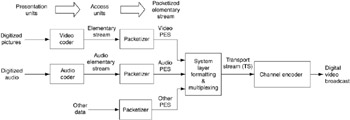
Broadcasting digital television signals involves multiplexing and formatting the coded audio and video elementary bitstreams, into packetised elementary streams (PESs) and multiplexing them together with relevant service PESs as well as PESs of other programmes. The multiplexed PESs are then formatted into 188-byte packets to form a transport stream as illustrated in Figure 7.1. This is followed by the channel encoder in which the transport stream is used to modulate a suitable carrier. The transport stream is fully defined by MPEG-2. MPEG-4 on the other hand is designed to be transport agnostic. This means that MPEG-4 coded data can be carried over different transport layers and could move from one transport layer to another. In the case of HDTV, an amendment to MPEG-2 s transport stream has been defined to carry MPEG-4 data. This involves introducing additional identification and other flags specifically for MPEG-4 packets. Transport of MPEG-4 over IP has also been defined.
Video and audio coders deliver their outputs in the form of an elementary stream ( ES). Raw uncompressed pieces of video or audio, known as presentation units are fed into their respective coders to produce video and audio access units. A video access unit could be an I, P or B coded picture. The audio access units contain coded information for a few milliseconds of sound window: 24 ms (layer II) and 24 or 8 ms in the case of window...