Oil Well Testing Handbook

Providing real-life examples and cases, this resource contains the basics of well testing methods as well as all of the latest developments in the field, including testing for horizontal wells.
 TABLE OF CONTENTS
 Transient pressure analysis of horizontal wells is more complex than that of vertical wells because of the following reasons:
Most horizontal well models assume that horizontal wells are perfectly horizontal and are parallel to the top and bottom boundaries of the reservoir. In general, the drilled horizontal wellbores are rarely horizontal, with many variations in the vertical plane along the well length, affecting pressure gauge inserted at the producing end of a horizontal well.
Calculation is not straightforward because horizontal wells exhibit negative skin factors.
It is difficult to estimate exact production length of a long horizontal well.
This section describes steady-state fluid flow through a reservoir. Mathematical equations are included for horizontal oil wells. In oil wells, normally pressure instead of pressure squared and pseudo-pressure methods are used to describe the relationship between pressures and flow rates.
Steady-state flow rate can be predicted by using several solutions which are available in the literature. [16]- [18] These solutions in US Oilfield Units are given as follows.
Joshi [18] Method
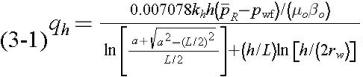
where

Giger etal. [16] Method
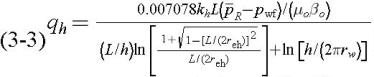
Borisov [17] Method

Giger etal. [16] Method
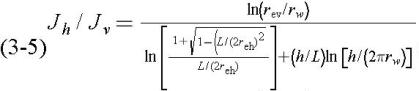
Renard and Dupay [19] Method

where
x = 2a/L for ellipsoidal drainage area
a = half the major axis of drainage ellipse (see Eq. 3-2).
Giger etal. [16] Method

In Eqs. 3-1 through 3-7
L = horizontal well length, ft
h = reservoir...