Oil Well Testing Handbook
Providing real-life examples and cases, this resource contains the basics of well testing methods as well as all of the latest developments in the field, including testing for horizontal wells.
 TABLE OF CONTENTS
 This chapter discusses various types and testing of layered oil reservoir systems including multilayered responses in fractured reservoirs. It also describes crossflow identification and the nature and degree of communication between layers. Performance equations for cases of constant flowing pressure and constant producing rate are presented and discussed. This chapter also reviews "layer effect" on pressure and/or production behavior including economic aspects of interlayer crossflow.
Figure 15-1 shows the classification of layered oil reservoir systems.
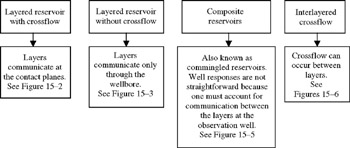
Multilayered reservoirs can be classified into two categories: layered reservoirs with crossflow, in which layers are hydrodynamically communicating at the contact places and layered reservoirs without crossflow, in which layers communicate only through the wellbore. This type of system without crossflow is also called a "commingled system."
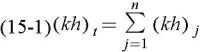
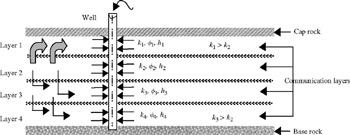
Figure 15-2 shows a four-layer oil reservoir with crossflow allowed between the layers. Pressure transient testing in such reservoirs is the same as the behavior of the homogeneous system. The following relationships can be applied for such systems.
Permeability-thickness product
Porosity-compressibility product
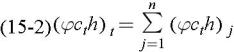
The total number of layers is n. The individual layer permeabilities may be approximated from

Figure 15-3 shows a four-layer reservoir with the layers separated by a shale barrier. Oil production is commingled at the well, so layers communicate only through the well. Early-time pressure drawdown behavior in such a...