Oil Well Testing Handbook

Providing real-life examples and cases, this resource contains the basics of well testing methods as well as all of the latest developments in the field, including testing for horizontal wells.
 TABLE OF CONTENTS
 The basic equations used for multi-phase pressure buildup analysis are quite similar to those used for single phase. The basic equation is

where the flow rates q1 through q n are re-expressed in total fluids q t (stb) as

Eq. 5-88 is that of a straight line of the form Y = b + mX where Y = p ws where
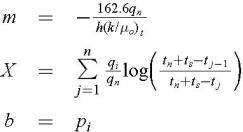
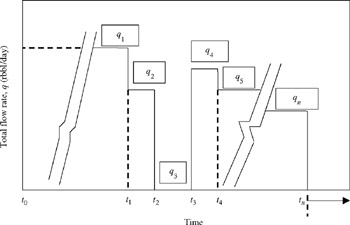
Figure 5-24 shows a hypothetical flow history of a well. Upon shut-in, a plot of the bottom-hole shut-in pressure versus the dimensionless summation Cartesian (Eq. 5-88) assumes a characteristic shape given in Figure 5-25. After the wellbore effects have dissipated, the straight-line relationship holds and the observed slope can be translated into values of total mobility:


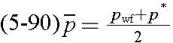
The gas and oil formation volume factors are pressure-dependent. It is recommended that as a first approximation they may be selected at the highest observed pressure. Later, for subsequent runs if desired they may be selected at average pressures given below:

To calculate the skin factor and its associated pressure drop, the following equations are used:


The factor, F, in Eq. 5-92 corrects for short flow times. In most other cases, F will equal or approach to 1.

In Eq. 5-92, the total compressibility, c t, is

For multiphase flow, below the saturation or bubble point pressure:

The gas compressibility may be estimated from correlation charts such as those...