Oil Well Testing Handbook
Providing real-life examples and cases, this resource contains the basics of well testing methods as well as all of the latest developments in the field, including testing for horizontal wells.
 TABLE OF CONTENTS
 Pressure should be recorded continuously during a transient test. Best results are obtained when the bottom-hole pressure is measured, although surface pressures often can be converted to bottom-hole values if adequate information is available about the wellbore system. It is usually beneficial to record bottom-hole, tubing-head, and casing-head pressures during a well test. This combination of data can provide information about wellbore effects, such as storage, and leaking packers or tubing. Such surface pressure data may be valuable in verifying correct operation of the down-hole pressure gauge. This appendix will describe two methods as shown below (see Figure C-1).
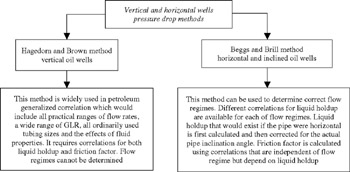
This method is widely used and most accepted in the petroleum industry. The procedure for this method is
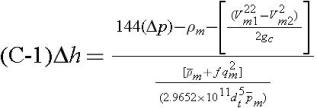
A step-by-step procedure for using Eq. C-1 and calculating a vertical pressure traverse by this method is given below.
Calculate average segment pressure and temperature.
Determine the total mass of oil, water, and gas associated with 1 barrel of stock tank liquid:

Find the flow rate at average segment point:

Determine physical properties R s, ? 0,  ,
,  , ? 0, and ? w from laboratory information or empirical correlations at average segment pressure and temperature.
Calculate the density of liquid phase:

Calculate the average gas density:

Estimate viscosity of the liquid mixture:

Estimate surface tension of liquid mixture:

Calculate liquid viscosity number:

Find