Oil Well Testing Handbook
Providing real-life examples and cases, this resource contains the basics of well testing methods as well as all of the latest developments in the field, including testing for horizontal wells.
 TABLE OF CONTENTS
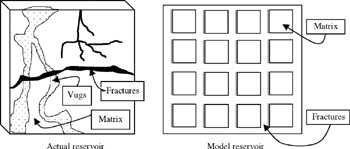
 Naturally fractured reservoirs are different from conventional (unfrac-tured) reservoirs. They are heterogeneous in type and consist of matrix blocks separated from one another by the fracture system as shown in Figure 7-1. The matrix blocks are made of the original rock that was present before fracturing took place. The matrix is characterized by its permeability k m and porosity ? m. The fracture system is characterized by its permeability k f and porosity ? f. It means a naturally fractured reservoir is a double-porosity and double-permeability reservoir. This chapter presents identification of fractures, main characteristics, and brief review of the most widely used well testing models.
It is essential to identify fractures during exploration and drilling. Well logs are useful tools in identifying these natural fractures. A program for fracture detection based on logging techniques consists of using different logs.
Borehole televiewer logs can be used to identify induced and natural fractures.
Acoustic, receptivity, and temperature logs can be used to obtain a realistic picture of fractures and their width and orientation in the vicinity of wellbore.
Variable-density logs can define fracture intervals.
Both core analysis and logging are valuable techniques for explored wells in detecting fracture porosity ? f, permeability k f, and nature of the matrix or intergranular porosity. However, there are many wells drilled where no core was taken and the logs do not...