Oil Well Testing Handbook

Providing real-life examples and cases, this resource contains the basics of well testing methods as well as all of the latest developments in the field, including testing for horizontal wells.
 TABLE OF CONTENTS
 In this section, we consider pressure buildup testing of a single well in an finite (bounded) and of a well in a developed (old) reservoir using methods commonly referred to as Horner, [8] MDH, [9] Muskat, [10] and Slider. [11]
The Horner and MBH methods are used to analyze the buildup data only for infinite-acting reservoirs. This is not true; Horner's method can be used to estimate the reservoir parameters in finite reservoirs just as in infinite-acting reservoirs. The difference occurs only in late-time data when boundary effects influence the data as shown in Figure 5-7.
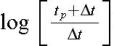
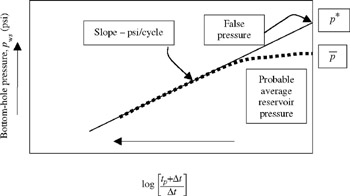
For an infinite-acting reservoir, an estimate of p i is obtained by extrapolating the straight-line section of the Horner plot to infinite shut-in time. For finite and developed reservoirs, the extrapolated pressure is not a good estimate of p i and generally has been called the false pressure, p *. As shown in Figure 5-7, the extrapolated false pressure, p *, is higher than the average reservoir pressure at the instant of shut-in unless the drainage region is highly skewed. Using the concept of the false pressure, we may rewrite Eq. 5-18 as

Ramey and Cobb [12] show that P * is related to p i by

where
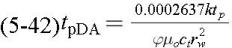
Although it is commonly believed that the Horner...