Oil Well Testing Handbook

Providing real-life examples and cases, this resource contains the basics of well testing methods as well as all of the latest developments in the field, including testing for horizontal wells.
 TABLE OF CONTENTS
 In an ideal situation, we assume that the test is conducted in an infinite-acting reservoir in which no boundary effects are felt during the entire flow and later shut-in period. The reservoir is homogeneous and containing in a slightly compressible, single-phase fluid with uniform properties so that the Ei function and its logarithmic approximation apply. Horner's approximation is applicable. Wellbore damage and stimulation is concentrated in a skin of zero thickness at the wellbore. Flow into the wellbore ceases immediately at shut-in. If a well is shut-in after it has produced at rate q for time t p and the bottom-hole pressure p ws is recorded at time ?t, then a plot p ws versus log (t p + ?t) ?t will give a straight line, which is represented by the following equation:

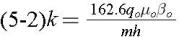
where the slope m is 162.6 q 0 ? 0 ? 0/ kh and p i (initial reservoir pressure) is the intercept at (t p + ?t)/ ?t = 1.0. The absolute value of the slope m is used in analyzing the test result. The formation permeability k can be calculated from the slope and given by

A new oil well produced 400 stb/day for  days; then it was shut-in for a pressure buildup test, during which the data in Table 5-1 were...