Oil Well Testing Handbook
Providing real-life examples and cases, this resource contains the basics of well testing methods as well as all of the latest developments in the field, including testing for horizontal wells.
 TABLE OF CONTENTS
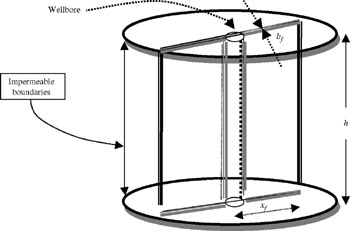
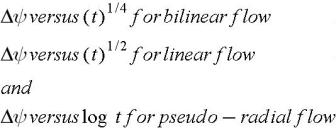
 Transient behavior of oil well with a finite-conductivity vertical fracture has been simulated by Cinco et al. Usually it is assumed that fractures have an infinite conductivity; however, this assumption is weak in the case of large fractures or very low-capacity fractures. Finite-conductivity vertical fracture in an infinite slab is shown in Figure 9-1. Transient behavior of a well with a finite-conductivity vertical fracture includes several flow periods. Initially, there is a fracture linear flow characterized by a half-slope straight line; after a transition flow period, the system may not exhibit a bilinear flow period, indicated by a one-fourth-slope straight line. As time increases, a formation linear flow period might develop.
Eventually, in all cases, the system reaches a pseudo-radial flow period. Pressure data for each flow period should be analyzed using a specific interpretation method such as
[2]Cinco, H., and Samaniego, F., "Effect of Wellbore Storage and Damage on the Transient Pressure Behavior for a Well with a Finite-Conductivity Vertical Fracture", Soc. Pet. Eng. J. (Aug. 1978), 253-264.
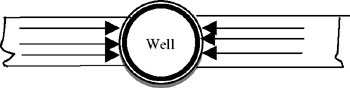
During this flow period, most of the fluid entering the wellbore comes from the expansion of the system within the fracture and the flow is essentially linear, as shown in Figure 9-2. Pressure response at the wellbore is given by


Eq. 9-2 indicates that a...