Oil Well Testing Handbook

Providing real-life examples and cases, this resource contains the basics of well testing methods as well as all of the latest developments in the field, including testing for horizontal wells.
 TABLE OF CONTENTS
 Average reservoir pressure, p ? R, can be determined from a pressure buildup test. Also, p ? R is referred to as static drainage area pressure in the formation surrounding a tested well. Average reservoir pressure is used:
To compute rock and fluid characteristics.
To estimate oil in-place.
To predict future reservoir behavior in primary/secondary recovery and pressure maintenance projects.
Note that initial or original reservoir pressure is different from average reservoir pressure. Average reservoir pressure is determined for reservoirs that have experienced some pressure depletion. Several methods are available to estimate average reservoir pressure.
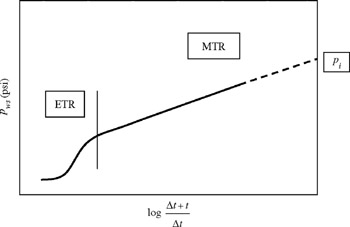
Original reservoir pressure, p i is found as suggested by ideal theory. We simply identify the middle-time line, extrapolate it to infinite shut-in time, and read the pressure that is the original reservoir pressure as shown in Figure 6-1.
This technique is possible only for a well in a new reservoir, i.e., one in which there has been negligible pressure depletion. For a reservoir with one or more boundaries relatively near a tested well, the late-time line must be extrapolated to find p i (Figure 6-2).

In this section we will discuss various methods to estimate average  and initial p i in both closed (no flow) and water-drive (constant pressure) oil reservoirs.