Oil Well Testing Handbook

Providing real-life examples and cases, this resource contains the basics of well testing methods as well as all of the latest developments in the field, including testing for horizontal wells.
 TABLE OF CONTENTS
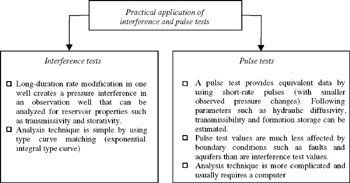
 Both interference and pulse tests, also known as multiple-well testing, involve more than one well. These types of tests can be used to obtain an adequate reservoir description for homogeneous (both isotropic and aniso-tropic) and heterogeneous systems. Numerical solutions must be used to analyze pressure transient data from heterogeneous systems. At the same time, it is one of the most important and useful tests to understand the well behavior in a water flood and enhanced oil recovery projects. Figure 13-1 shows field application of interference and pulse tests.
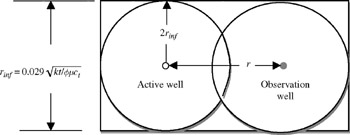
Interference testing is one form of multiple-well testing. These tests are used to determine whether two or more wells are in pressure communication in the same reservoir and, when communication exists, to provide estimates of vertical formation permeability k and porosity/compressibility product ? C t, in the vicinity of the tested wells. In the homogeneous isotropic system, the porosity and thickness are the same everywhere in the reservoir. Permeability k is also the same everywhere and in all direction. Interference is conducted by producing from or injecting into one of these wells (active well) and the pressure response is observed in the other well (observation well) (see Figure 13-2). The active well starts producing at uniform pressure at time zero and the other pressure response in the observation well at a distance r from active well begins after some time lag.