Electro-Optics Handbook, Second Edition
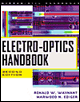
Developed by a towering figure in the field, this valuable, all-inclusive guide thoroughly explains and discusses the use of optical devices and light in electronics systems.
 TABLE OF CONTENTS
 Ronald W. Waynant and Marwood N. Ediger
The field of electro-optics has become increasingly more important in the last 20 years as its prodigies and applications have found their way into most facets of science, industry, and domestic use. This near-revolution, which essentially started with the advent of the laser, has been the result of extensive parallel and often symbiotic development of sources, materials, and microelectronics. The combination of these technologies has enabled a great variety of compact devices with ever greater intelligence and performance. If source development was instrumental in initiating the field, materials and detectors were the binding elements. Vast improvements in optical materials have made fiber optics feasible and the availability of high-quality, affordable fibers has, in turn, made optical circuits and a variety of optical sensors possible. Refinement and development of new materials have resulted in an astonishing variety of devices to modulate, polarize, frequency-shift, and otherwise control coherent radiation. In turn, detectors have achieved greater performance and smaller size and cost.
The second edition of this handbook attempts to cover a broad spectral bandwidth-from x-rays to far infrared. A primary motivation in extending the short-wavelength limit of the source spectrum, and the handbook's coverage of it, is the demand for higher resolving powers in materials and device fabrication applications as well as medical and biological imaging. Figure 1.1 depicts the size of objects of interest in the biological, materials science, and electronics worlds, and the wavelength necessary to resolve them as prescribed by...