Electro-Optics Handbook, Second Edition
Developed by a towering figure in the field, this valuable, all-inclusive guide thoroughly explains and discusses the use of optical devices and light in electronics systems.
 TABLE OF CONTENTS
 Roland Sauerbrey
The term laser is an acronym for a radiation source based light on amplification by stimulated emission of radiation. The foundation for lasers was established with the first formulation of a quantum theory of light by Planck and Einstein.1 Later, the technological development of lasers was stimulated by the invention of various microwave devices, which led in the 1950s to microwave amplifiers based on stimulated emission of radiation ( masers). The quest for the development of devices based on this principle but operating at higher frequencies or shorter wavelengths started then and continues up to the present time. It led in 1960 to the construction and operation of the first laser that emitted visible radiation by Maiman.2 Today, lasers deliver radiation over large portions of the electromagnetic spectrum, ranging from the far infrared to the soft x-ray region (Fig. 3.1).
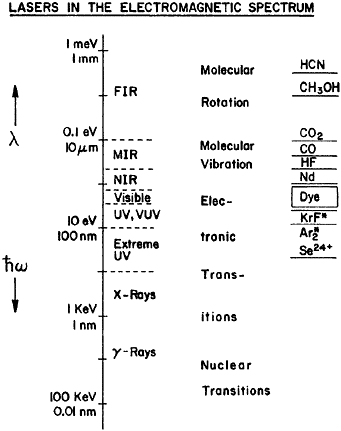
 1.2316 m.) The second column gives the most frequently used name for the respective part of the electromagnetic spectrum. The third column denotes the most common mechanism that produces radiation in any part of the spectrum, and the right-hand column gives some examples of typical lasers.
In principle, most lasers consist of three parts3 (Fig. 3.2): (1) a pump source, (2) an active medium, and (3)...