Electro-Optics Handbook, Second Edition
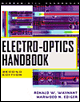
Developed by a towering figure in the field, this valuable, all-inclusive guide thoroughly explains and discusses the use of optical devices and light in electronics systems.
 TABLE OF CONTENTS
 Gary L. Wood and Edward J. Sharp
The introduction of the visible laser, first demonstrated1 experimentally on May 15, 1960, marked the beginning of the rapid expansion of nonlinear optics.2 Today, the field of nonlinear optics remains very active in both a basic and an applied sense. New nonlinear effects have been discovered and are being explored both experimentally and theoretically. The technology has continued to mature, and refinements in the development of lasers and high-quality optical materials have resulted in a variety of commercially available nonlinear optical devices. A number of good references are devoted to introducing the reader to the broad field of nonlinear optics.3 -9
The interaction of light with matter includes both a linear as well as a nonlinear component. Even though the nonlinear component is usually weak and often not noticeable, it can become dominant at optical resonances or for large incident intensities, such as those produced with laser beams. For instance, it has been observed that the optical behavior of many materials deviates from the linear behavior found in Snell's and Beer's law at high intensities. This is due to the fact that these laws are approximations and are only valid at low intensities. In general, the index of refraction n and the absorption coefficient ? are intensity-dependent,
| (13.1a) |  |
| (13.1b) |  |
where I is the incident intensity.
A full quantum-mechanical treatment is necessary in order to describe the detailed behavior of nonlinear optics. A number of nonlinear effects, such...