Electro-Optics Handbook, Second Edition

Developed by a towering figure in the field, this valuable, all-inclusive guide thoroughly explains and discusses the use of optical devices and light in electronics systems.
 TABLE OF CONTENTS
 Gary L. Wood
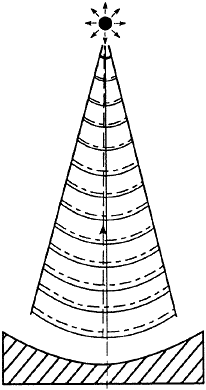
Real time phase conjugation from nonlinear media was first observed and explained as a conjugate beam by Zel'dovich and his coworkers in the Soviet Union in 1972.1 It was noticed that a high-intensity ruby laser beam ( ? = 694 nm) focused into methane gas caused a retrobeam to emerge with unusual properties. The retrobeam seemed to propagate from the medium back to the source without diverging but actually converging (see Fig. 14.1). In other words, this retrobeam retraced the incident beam. In addition, it was observed that the retrobeam would restore any phase aberrations (see Fig. 14.2). The retrobeam became known as a phase conjugate beam. Phase conjugation has since been observed in many media and from several different physical mechanisms; for example, see Ref. 2 for a list of materials in which phase conjugation has been observed. Although phase conjugation is mostly observed in the visible to infrared part of the spectrum ( ? = 400 nm to 10.6 m) there is no reason it should be limited to this region. Phase conjugation should be observable from microwave3 to x-ray4 wavelengths in the near future with suitable sources and nonlinear materials. The many implications of phase conjugation are still not known and could affect basic physical processes in unexpected ways.5 ,6 There also seem to be many potential applications of phase conjugation.