Electro-Optics Handbook, Second Edition
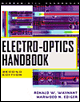
Developed by a towering figure in the field, this valuable, all-inclusive guide thoroughly explains and discusses the use of optical devices and light in electronics systems.
 TABLE OF CONTENTS
 Frederick A. Rosell
Although television imagery was demonstrated in the late 1920s, it has become a household word since the end of World War II. Basically, television uses imaging sensors to convert photon images, which have been focused by lenses onto a photosensitive surface, to electron images. These electron images are reconverted to visible light images for direct or remote viewing by an observer. While the displayed image must be in the visible, the input image may be formed in any spectral band from the ultraviolet to the far infrared. In the broad sense, these sensors should be called image converters. In this chapter, the sensors considered will be restricted to those operating in the ultraviolet to near-infrared portion of the spectrum (0.2 to 1.1 m).
Direct-view imagers convert a photon image incident on a photoemitter to an electron image that is then accelerated to a phosphor which creates a visible image directly. The World War II sniperscope used a scene illuminator filtered to exclude the visible spectrum and a near-infrared direct-view image converter for nighttime infantry actions. After World War II, direct-view light amplifiers (multiple-stage intensifiers) were developed which can image at light levels down to natural starlight without the aid of auxiliary scene illuminators.
The TV broadcast industry developed camera tubes for entertainment use. The standard camera tube used was the image orthicon, or IO, which was of moderately high sensitivity because of a prestorage electron image gain mechanism and a very low noise preamplifier. To...