Electro-Optics Handbook, Second Edition
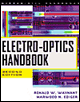
Developed by a towering figure in the field, this valuable, all-inclusive guide thoroughly explains and discusses the use of optical devices and light in electronics systems.
 TABLE OF CONTENTS
 Sharon Miller
In this chapter, the fundamentals of noncoherent or "nonlaser" optical radiation are discussed. Noncoherent radiation consists of electromagnetic waves whose amplitude and phase fluctuate randomly in space and time. The most familiar source of noncoherent optical radiation, and the first to be studied by experimental scientists, is the sun. The concepts and terms necessary for the characterization of both the sun and artificial sources are provided. In addition, the practical aspects of proper measurements and the problems associated with this task are discussed.
The wavelength region for optical radiation spans from approximately 100 nanometers (nm) to 1000 micrometers ( m). The optical radiation spectrum can be broken up into three basic regions:
| Ultraviolet (uv) | 100 nm-400 nm |
| Visible | 400 nm-760 nm |
| Infrared (ir) | 760 nm-1000 m |
There is some controversy over the exact cutoff between the uv and visible region (380 to 400) and also between the visible and irregion (760 to 800). In the field of physics, the uv and ir regions are further divided into the "near" (300 to 400 nm), "mid" (200 to 300 nm), and "far" (30 to 200 nm) categories in the uv, and the "near" (760 to 4000 nm), "mid" (4 to 14 m), and "far" (14 to 1000 m) categories in the ir. In photobiology or photomedicine, it is more common to use biologically meaningful divisions, or the A, B, and C categories as defined by the CIE.1 They are: UVC (100 to 280 nm), UVB...