Electro-Optics Handbook, Second Edition
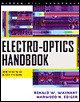
Developed by a towering figure in the field, this valuable, all-inclusive guide thoroughly explains and discusses the use of optical devices and light in electronics systems.
 TABLE OF CONTENTS
 G. Rodriguez, S. B. Kim, and J. G. Eden
In its most general sense, spectroscopy encompasses the study of the structure of matter by the observation of its interaction with electromagnetic radiation. Not only are those frequencies at which a species absorbs radiation of interest, but, once one or more photons are consumed, detailed information regarding the structure of an atom or molecule is revealed by the manner in which it disposes of the additional energy. At first glance, then, the various branches of spectroscopy at optical wavelengths can be categorized on the basis of (1) the number of photons absorbed by the atom or molecule under study and (2) the experimental technique chosen to detect a specific product generated by the optical process.
Spectroscopy and photochemistry are both undergirded by the characteristic of matter to absorb radiation at specific wavelengths in the electromagnetic spectrum. As shown qualitatively in Fig. 20.1 for crown glass (after Ref. 1), absorption by a molecule (or atom) at different points in the spectrum corresponds to energizing or exciting various degrees of freedom of the molecule. The tantalizing opportunity that awaits the spectroscopist or photochemist, therefore, is the ability to excite specific states or modes of a molecule and to observe its subsequent behavior. One may wish to isolate the molecule and determine the way in which it responds to the excitation (i.e., radiating another photon, dissociating, ejecting an electron, etc.) or it may be useful to allow the excited molecule to transfer...