Electro-Optics Handbook, Second Edition
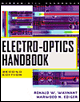
Developed by a towering figure in the field, this valuable, all-inclusive guide thoroughly explains and discusses the use of optical devices and light in electronics systems.
 TABLE OF CONTENTS
 John A. Pasour
The free-electron laser (FEL) is different in many ways from other types of lasers. As the name suggests, the radiation from the FEL is produced by a beam of free or unbound electrons. The electrons radiate when they are forced to oscillate in a regular fashion by an appropriate applied field. Unlike typical lasers, the FEL can be described completely by classical mechanics, at least for the operating regimes demonstrated to date. Thus the FEL has more in common with synchrotron light sources and microwave tubes than with conventional lasers. However, like other lasers, the FEL is capable of generating highly coherent, near-diffraction-limited radiation. Since their origins in the 1970s, great strides have been made in both the theoretical understanding of the FEL interaction and the experimental verification of the many promising predictions of the theory. Experimental research has advanced from the first demonstrations of the physical mechanism to the operation of numerous successful devices at laboratories around the world. These FELs operate at wavelengths from 10 ? 5 to 1 cm, and some have power levels in excess of any other source in their spectral regime.
The large amount of research on FELs has been motivated primarily by the unique capabilities of the device and the many applications which require these features. One of the most attractive features of the FEL is its tunability. The FEL output frequency is determined by continuously variable experimental parameters, such as the kinetic energy of the electrons...