Electro-Optics Handbook, Second Edition
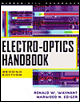
Developed by a towering figure in the field, this valuable, all-inclusive guide thoroughly explains and discusses the use of optical devices and light in electronics systems.
 TABLE OF CONTENTS
 Beth A. Koelbl
An optical amplifier (OA) is a term commonly given to a component, module, or sub-system that increases optical signal power without performing Optical-to-Electrical (O/E) and Electrical-to-Optical (E/O) conversions. In general, an OA is bitrate and format independent. Initial telecommunications applications for OAs were limited to regenerator replacement and as a means for increasing the bitrate of otherwise loss-limited links. However, the technology has matured quickly and the number of applications has grown rapidly.
For video applications, OAs have enabled significant increases in the number of optical distribution splits and video trunking distances. Currently, OAs enable telecommunications network operators to deploy Dense Wavelength Division Multiplexed (DWDM) systems and create All-Optical Networks (AONs). Within an AON, OAs not only amplify multipleoptical signals, but also perform wavelength conversion, all-optical add/drop multiplexing, logic functions in the optical domain, and all-optical memory functions. OAs have also improved fiber optic instrumentation, such as Optical Time Domain Reflectometers (OTDRs) and Fiber Optic Gyroscopes (FOGs).
This chapter discusses the main types of OAs: Optical Fiber Amplifiers (OFAs), Semiconductor Optical Amplifier (SOAs) (sometimes termed Semiconductor Laser Amplifiers (SLAs)), and Planar Waveguide Amplifiers (PWAs). It details the physical principles of light amplification, performance parameters, and applications for this technology.
The basic elements an Optical Fiber Amplifier (OFA) consist of a pump laser, a Wavelength Division Multiplexer (WDM), and an active optical fiber  as illustrated in Fig. 28.1. The signal(s) and optical pump power are coupled to the "active"...