Electro-Optics Handbook, Second Edition
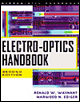
Developed by a towering figure in the field, this valuable, all-inclusive guide thoroughly explains and discusses the use of optical devices and light in electronics systems.
 TABLE OF CONTENTS
 Hiroshi Nishihara, Masamitsu Haruna, and Toshiaki Suhara
An optical integrated circuit (OIC) is a thin-film-type optical circuit designed to perform a function by integrating a laser diode light source, functional components such as switches/ modulators, interconnecting waveguides, and photodiode detectors, all on a single substrate. Through integration, a more compact, stable, and functional optical systemcan be produced. The key components are slab [two-dimensional (2-D)] or channel [three dimensional (3-D)] waveguides. Therefore, the important point is how to design and fabricate good waveguides using the right materials and processes. Some theories and technologies have been investigated by many researchers, and published in several technical books.1 -4
The features of OICs are4
Single-mode structure: waveguide widths are on the order of micrometers and are such that a single-mode optical wave propagates.
Stable alignment by integration: the device can withstand vibration and temperature change; that is the greatest advantage of OICs.
Easy control of the guided wave.
Low operating voltage and short interaction length.
Faster operation due to shorter electrodes and less capacitance.
Larger optical power density.
Compactness and light weight.
The basic structure of a 2-D (or slab) waveguide is shown in Fig. 26.1 with the index profiles along the depth, where the indices of the cladding layer, guiding layer, and substrate are n c, n f, and n s, respectively. In the case that n