Electro-Optics Handbook, Second Edition
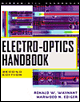
Developed by a towering figure in the field, this valuable, all-inclusive guide thoroughly explains and discusses the use of optical devices and light in electronics systems.
 TABLE OF CONTENTS
 David H. Sliney
The greatest experience in the safe use of lasers has been derived from over 30 years of working with lasers in the research laboratory. Today, most potentially hazardous laser exposures still occur in the research and engineering laboratory, where engineering safety enclosures are impractical to use.
Only shortly after the development of the first laser were the physiological implications of lasers considered.1 After several research programs in the 1960s aimed at studying the adverse biological effects of lasers and other optical radiation sources, laser occupational exposure limits were set and general safety standards were developed.2 -4 Today, the experience from laser accidents and the development of new lasers and new applications have altered the format of the exposure limits and the safety procedures.4 -9
Laser safety exposure limits (ELs) and safety procedures vary considerably with the wavelength and type of laser. It is critically important to distinguish between different biological injury mechanisms. For example, the biological effects of ultraviolet radiation on the skin and eye are additive over a period of at least one workday, and require different safety procedures. The scattered ultraviolet (uv) irradiance from excimer lasers may be quite hazardous, depending on wavelength and action spectra. Since laser technology is young, the exposure of an individual in natural sunlight must be studied to evaluate the potential for chronic effects. The safety measures necessary in the use of lasers depend on a hazard evaluation. The appropriate control measures and alternative means of...