Electro-Optics Handbook, Second Edition
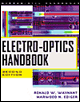
Developed by a towering figure in the field, this valuable, all-inclusive guide thoroughly explains and discusses the use of optical devices and light in electronics systems.
 TABLE OF CONTENTS
 Thomas Liljeberg and John E. Bowers
Since shortly after the first demonstration of a semiconductor laser, researchers were aware of the potential for high-speed operation.1 Today, the fastest semiconductor laser shave small-signal modulation bandwidths of over 40 GHz,2 -5 with the potential of reaching at least 60 GHz with existing device technology. Photodetectors have shown an even more remarkable increase in bandwidth; currently detectors with over 500 GHz are reported from research labs, and detectors with over 60 GHz bandwidth and good efficiency are commercially available. These fast devices are key elements in a long list of applications, with fiber-optic telecommunication as perhaps the most important.
A number of factors limit the bandwidth of semiconductor lasers and detectors, ranging from intrinsic material and physics limits to technology and device structure limits. It is impossible to thoroughly cover all this in a short chapter, instead a short review of these bandwidth limiting effects and an extensive list of references will be provided. In the laser section, we focus on the small signal response of semiconductor lasers, with less attention given to issues specific to large-signal modulation. It should be noted, however, that some of the large-signal effects, such as chirp, ringing and distortion are important parametersfor many applications. In terms of modulation bandwidth, a laser with high small-signal modulation bandwidth will generally also have a high large-signal bandwidth.
In the detector section, we give a review of the various semiconductor detector types important for high-speed applications. The focus is on...