Electro-Optics Handbook, Second Edition
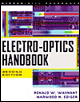
Developed by a towering figure in the field, this valuable, all-inclusive guide thoroughly explains and discusses the use of optical devices and light in electronics systems.
 TABLE OF CONTENTS
 Carlton M. Truesdale
The progress of optical fiber technology is embedded in dreams of revolutionizing the way we communicate with one another. Systematically, the building blocks have been created and mass-produced so that those dreams are becoming real. The basic rece iver was in existence in the 1950s. The laser appeared in 1960 and the demonstration of the first roomtemperature continuous-wave semiconductor laser by Hayashi and Panish1 at Bell Laboratories in 1970 made possible the transmission and reception of information using signals of light. This technology is being used to rewire America and the world.
Kapany and Simms announced the fabrication of the first infrared optical fiber in 1965.2 This chalcogenide glass fiber had transmission loss of more than 10,000 dB/km. By 1970 Corning researchers Kapron, Keck, and Maurer had fabricated silica-based optical fibers that reached the 20 dB/km milestone.3 By reducing the impurities in the source materials and improving the homogeneity of the glass processing, an attenuation of 0.2 dB/km was obtained by Miya, Hosaka, and Miyashita.4 In 1978, Pinnow,5 Van Uitert,6 and Goodman et al.7 proposed that an ultra-low-loss fiber with a loss less than 0.01 dB/km for non-silica-based fibers was theoretically possible. This announcement motivated many researchers to study and discover other infrared materials.
Today standard silica-based optical fiber for optical communications typically has less than 0.2 dB/km attenuation as measured at 1550 nm. Optical fibers have come a long way and are becoming a more refined technology.
The...