Electro-Optics Handbook, Second Edition
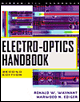
Developed by a towering figure in the field, this valuable, all-inclusive guide thoroughly explains and discusses the use of optical devices and light in electronics systems.
 TABLE OF CONTENTS
 Jack C. Rife
This chapter discusses properties and selection of ultraviolet (uv) window, mirror, and coating materials. The uv range of the electromagnetic spectrum extends from energies (wavelengths) of about 3 eV (400 nm) just outside the visible to a vague boundary near 6000 eV (0.2 nm), the start of the x-ray range. This chapter primarily discusses spectral ranges in terms of energy. An energy scale better serves spectroscopy, since prominent spectral features across the whole range have the imprint of a relatively narrow range of unoccupied final electronic states. A wavelength scale will be used at times, however, to emphasize the longer wave-lengths and provide a useful gauge for thin film dimensions. A useful conversion factor is that the wavelength in ? nm is given by ? = 1239.8/ E , where E is the energy in eV.
The uv and x-ray ranges of the electromagnetic spectrum divide into subregions that are overlapping and whose boundaries are not commonly agreed on. Figure 10.1 shows the approximate ranges of the various named regimes and physical phenomena that determine experimental ranges. The near uv extends from just outside the visible at 3 eV to the beginning of the vacuum uv at 6.7 eV, where air is no longer transparent and vacuum is required. This is the region where radiation begins to be energetic enough to be ionizing. The vacuum uv extends to the beginning of the x-ray region proper at 2000 to 6000 eV where He...