Integrated Circuit Packaging, Assembly and Interconnections
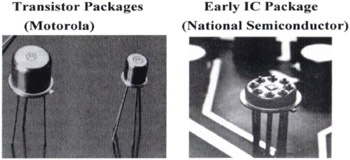
Starting with the transistor, the package has functioned as both a carrier and as an enclosure. As a carrier it allows the device s functionality to be fully accessed and to be assembled and electrically interconnected to other devices (Level 2.0). As an enclosure it provides protection from physical damage and a supportive and controlled operating environment for the device. The earliest ICs followed the same packaging format as the transistor (a TO-5 metal package) differing only in the number of leads (Figure 3-1).
Physically the package has undergone many changes, responding to the needs of the IC, the end product, and certainly cost considerations. Ideally the guidelines have always been to:
Provide a package that fully supports the IC, responding to inherent thermal, mechanical and electrical requirements,
Avoid, if possible, having the package limit chip performance,
Make the package as small as possible, and finally,
Provide a cost-effective package that does not represent a substantial percentage of the final device s selling price.
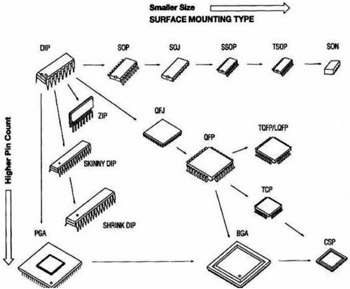
Figure 3-2 graphically presents the industry s past history and current trends in IC packages. In particular, it shows the influence of accommodating both increasing I/O count and miniaturization.
The package miniaturization has been driven by the continuing demand for smaller, better, cheaper end product. Miniaturization is marked not only by a smaller package, but...