Integrated Circuit Packaging, Assembly and Interconnections
The cost factor associated with chip & wire assembly was one of increasing concerns with the emergence of the IC. This precipitated major development programs in most semiconductor houses directed towards new, less costly assembly processes. These included Beam Leads (BL) from Bell Laboratories, Flip Chip (FC) from IBM, and Tape Automated Bonding (TAB) from General Electric. From these efforts, two technologies survive and currently provide alternatives to chip & wire assembly for the IC, flip chip (FC) and TAB.
Flip chip, as an alternative first level assembly process, was developed by IBM in the 1960s and was introduced in 1973 on the IBM System 3 mainframe computer. Delco, also in the early 1970s, became active in applying flip chip technology to a bourgeoning automotive electronics market.
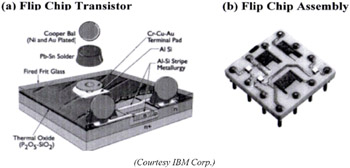
Figure 10-1 is a schematic of the IBM flip chip transistor and shows a ceramic package containing 3 flip chip transistors. The package is ceramic with screen printed conductors and resistors.
The manufacturing process for the flip chip included:
Deposition and patterning of a glass frit (for passivation ) to expose the Al bonding pads, and
Deposition and patterning, using a metal mask, of a solderable material (Cr-Cu-Au) over the exposed Al bond pads.
This layered metallurgy is referred to as the Under Bump Metallization, or UBM. Using a solder perform over each pad, Ni and Au plated...