Integrated Circuit Packaging, Assembly and Interconnections
Chapter 8: Chip & Wire Assembly

8 CHIP & WIRE ASSEMBLY [1]

Chip & Wire assembly involves the attachment of the die to a package or substrate followed by connecting wires from the die bond pads to the same package or substrate. Bell Laboratories originally developed this attachment technology in the late 1950s for the assembly of silicon planar transistors. Three connections were needed, one to the back of the Si die, the collector electrode, and two to the top surface, the emitter and base electrodes. Attachment to the collector was achieved by alloy bonding the die to a gold plated package. This was realized by placing the Si die in contact with the Au plating while simultaneously applying heat (~400 C), agitation, and pressure.

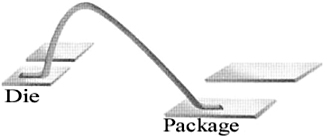
Attachment to the emitter and base electrodes involved bonding Au wires (1 or 2 mils diameter) by application of heat (~350 400 C) and pressure (~40 80 gram force). This thermocompression (TC) bonding process was totally operator dependent and a fully manual operation. The operator was required to separately align the wire and the bonding tool, first to the pads on the die and then to the package pads. A wedge shaped bond was formed at the die pad and the package similar to that shown schematically in Figure 8-1.


Figure 8-1: Classic Wedge Wire Bond

8.1 Die/Wire Bonding and Bonder Equipment Development [2]

Specially designed, but manually operated die bonders and wire bonders were used early on for assembly. Highly skilled and specially trained operators were essential for both the die and wire...

UNLIMITED FREE
ACCESS
TO THE WORLD'S BEST IDEAS

SUBMIT
Already a GlobalSpec user? Log in.

This is embarrasing...

An error occurred while processing the form. Please try again in a few minutes.

Customize Your GlobalSpec Experience

Category: Semiconductor Wire and Wedge Bonders
Finish!
Privacy Policy

This is embarrasing...

An error occurred while processing the form. Please try again in a few minutes.