Integrated Circuit Packaging, Assembly and Interconnections
Early ceramic IC packages were manufactured using the thick film process for the metallization. A metal interconnect was selectively deposited onto a ceramic substrate by screen printing a patterned conductive paste or ink. A drying and firing of the patterned paste followed the screening. This same basic process, print, dry, and fire continues to be used today in the manufacture of much more complex multilevel conductor interconnect substrates for MCPs, in particular hybrids and MCMs. A MCP when manufactured using thick film processes is referred to as a MCM-C.
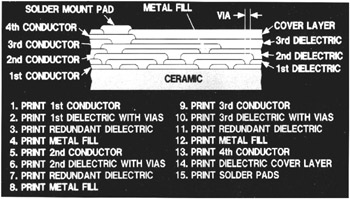
The thick film substrate manufacturing process for multilevel applications is a sequential build up process and is schematically detailed in Figure 13-1.
The entire process begins with selection of the substrate. The majority of applications call for inorganic substrates primarily ceramic because of the high process temperatures involved. The most commonly used substrates include aluminum oxide or alumina (Al 2O 3), clearly the most dominant, beryllium oxide (BeO), and aluminum nitride (AlN). The selection is based primarily on the end application. For example, if there are heat dissipation issues to be addressed, BeO and AlN would be preferred in deference to Al 2O 3. BeO offers high thermal conductivity while AlN has slightly lower thermal properties but a CTE better matched to silicon. A list of various ceramic and metal substrates with their respective thermal properties is shown Table 12-9...