Metal Forming: Mechanics and Metallurgy, Third Edition
An understanding of stress and strain is essential for analyzing metal forming operations. Often the words stress and strain are used synonymously by the nonscientific public. In engineering, however, stress is the intensity of force and strain is a measure of the amount of deformation.
Stress is defined as the intensity of force, F, at a point.
where A is the area on which the force acts.
If the stress is the same everywhere,
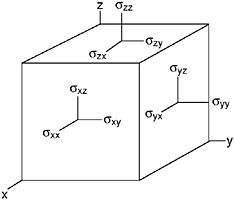
There are nine components of stress as shown in Figure 1.1. A normal stress component is one in which the force is acting normal to the plane. It may be tensile or compressive. A shear stress component is one in which the force acts parallel to the plane.
Stress components are defined with two subscripts. The first denotes the normal to the plane on which the force acts and the second is the direction of the force. [*]For example, ? xx is a tensile stress in the x-direction. A shear stress acting on the x-plane in the y-direction is denoted ? xy.
Repeated subscripts (e.g., ? xx , ? yy , ? zz) indicate normal stresses. They are tensile if both subscripts are positive or both are negative. If one is positive and the other is negative, they are compressive. Mixed subscripts (e.g., ? zx , ? xy , ? yz)...