Metal Forming: Mechanics and Metallurgy, Third Edition

This chapter introduces the work or energy balance, which is a very simple method of estimating the forces and energy involved in some metal forming operations. It does not, however, permit predictions of the resulting properties. The energy to complete an operation can be divided into the ideal work, w i , that would be required for the shape change in the absence of friction and inhomogeneous flow, the work against friction, w f , and the redundant work, w r.
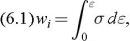
To calculate the ideal work, it is necessary to envision an ideal process for achieving the desired shape change. It is not necessary that the ideal process be physically possible. For example the axially symmetric deformation in the extrusion or wire drawing of an circular rod or wire can be simulated by tension test. The fact that necking would occur in a tension test can be ignored. The ideal work is
where ?=ln (A 0 /A f ). With power-law hardening,
Other expressions of work hardening, if more appropriate, can be used with equation 6.1.
EXAMPLE 6.1: The strain hardening behavior of a metal is approximated by
MPa. Find the work per volume if a bar of the material is reduced from 12.7 to 11.5 mm diameter in tension.
SOLUTION: This is an ideal process. Using equation 6.2,
=2ln(12.7/11.5)= 0.199.
A frictionless compression test could serve as the ideal process for forging. Flat rolling can be simulated by...