Metal Forming: Mechanics and Metallurgy, Third Edition
One can always determine the direction of one principal stress at a boundary. The following boundary condition are useful:
The force and stress normal to a free surface is a principal stress, so the ?- and ?-lines must meet the surface at 45 .
The ?- and ?-lines must meet a frictionless surface at 45 .
The ?- and ?-lines meet surfaces of sticking friction at 0 and 90 .
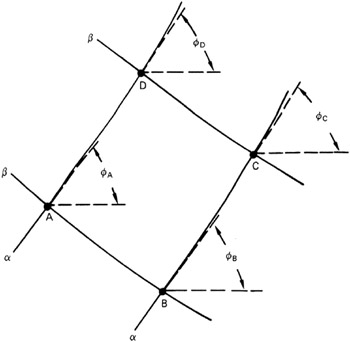
Equations 9.7 establish a restriction on the shape of statically admissible fields. Consider the field in Figure 9.6. The difference between ? 2 at A and C can be found by traversing either of two paths, ABC or ADC. On the path through B, ? 2B =
and
. On the other hand traversing the path ADC,
and
. Comparing these two paths,
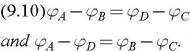
Equation 9.10 implies that the net of ? and ? lines must be such that the change of
is the same along a family of lines moving from one intersection with the opposite family to the next intersection. This together with the orthogonality requirement indicates that it is the angular change along a line rather than the length of line that is of significance.