When metals are deformed plastically at temperatures lower than would cause recrystallization, they are said to be cold worked. Cold working increases the strength and hardness. The terms work hardening and strain hardening are used to describe this. Cold working usually decreases the ductility.
Tension tests are used to measure the effect of strain on strength. Sometimes other tests, such as torsion, compression, and bulge testing are used, but the tension test is simpler and most commonly used. The major emphasis in this chapter is the dependence of yield (or flow) stress on strain.
3.1 THE TENSION TEST
The temperature and strain rate influence test results. Generally the strain rate is in the order of 10 ? 2 to 10 ? 3/s and the temperature is between 18 and 25 C. These effects are discussed in Chapter 5. Measurements are made in a gauge section that is under uniaxial tension during the test.
Initially the deformation is elastic and the tensile force is proportional to the elongation. Elastic deformation is recoverable. It disappears when the tensile force is removed. At higher forces the deformation is plastic, or nonrecoverable. In a ductile material, the force reaches a maximum and then decreases until fracture. Figure 3.1 is a schematic tensile load-extension curve.
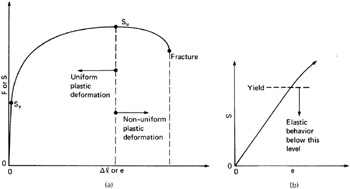 Figure 3.1: (a) Load-extension and engineering stress-strain curve of a ductile metal, (b) Expansion of initial part of the curve.
 Stress and strain are computed from measurements in a tension test of the tensile force, F,
Copyright William F. Hosford 2007 under license agreement with Books24x7

 TABLE OF CONTENTS