Metal Forming: Mechanics and Metallurgy, Third Edition

Chapter 4: Instability

Different phenomena limit the extent to which a metal may be deformed. Buckling may occur under compressive loading if the ratio of height-to-diameter is too great. Fracture may occur under tension. The thrust in this chapter is with a different type of phenomenon, called plastic instability. When a structure is deformed, there is often a maximum force or maximum pressure after which deformation continues at decreasing loads or pressures. It is assumed throughout this chapter that the strain hardening is described by . If other expressions better represent the behavior, they can be used with the same procedures. Solutions for effective strain at instability are functions of n.

4.1 UNIAXIAL TENSION

In a tension test of a ductile metal, the deformation is uniform up to maximum load. After this, localized deformation starts to form a neck. Since F= ?A, the condition for maximum load can be expressed as


Rearranging,


or


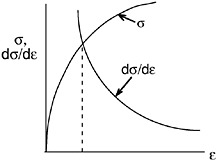
This is illustrated in Figure 4.1.


Figure 4.1: The maximum load in tension is reached when d ?/d ?= ?.

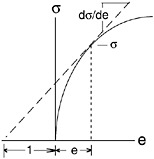
Since ?=ln(1+ e), d ?=d e/(1+ e). Substituting into equation 4.3, the condition for necking can be expressed as d ?/d e= ?/(1+ e). This is illustrated by the construction in Figure 4.2, which has been attributed to Consid re. [*] With power-law hardening,


Figure 4.2: Consid re construction for necking in tension. The critical condition for necking is d ?/de= ?/(1+e).

Thus...

UNLIMITED FREE
ACCESS
TO THE WORLD'S BEST IDEAS

SUBMIT
Already a GlobalSpec user? Log in.

This is embarrasing...

An error occurred while processing the form. Please try again in a few minutes.

Customize Your GlobalSpec Experience

Category: Metal Sheet
Finish!
Privacy Policy

This is embarrasing...

An error occurred while processing the form. Please try again in a few minutes.