Metal Forming: Mechanics and Metallurgy, Third Edition

All sheet-forming operations involve some bending. Often it is a major feature. Spring-back occurs after the bending forces are removed and the material contains residual stresses. If the bend radius is too sharp, there may be tensile failure on the outside of the bend or buckling on the inside. A very simple case is considered initially to illustrate the mechanics involved.
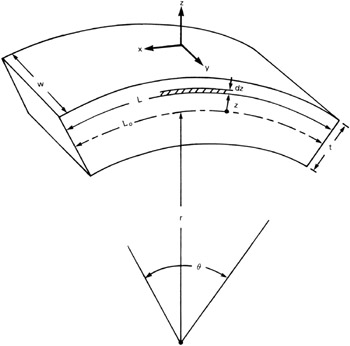
Consider the bending of a flat sheet of a non-strain-hardening material subjected to a pure bending moment. Figure 12.1 shows the coordinate system. Let r be the radius of curvature measured at the mid-plane and let z be the distance of an element from the mid-plane. The engineering strain at z can be derived by considering the arc length L, measured parallel to the surfaces of the sheet in the x-direction. The arc length at the mid-plane, L 0 , doesn t change during bending and may be expressed as L 0 =r , where ? is the bend angle. At z, the arc length is L=(r+z) ?. Before bending, both arc lengths were equal so the engineering strain, e, is
The true strain, ? x , is
For many bends the strains are low enough so we can approximate
With wide sheets (w
t) the width strain, ? y , is negligible. Therefore sheet bending can be considered to be a plane-strain operation, ?