Metal Forming: Mechanics and Metallurgy, Third Edition

9.8: METAL DISTORTION

9.8 METAL DISTORTION

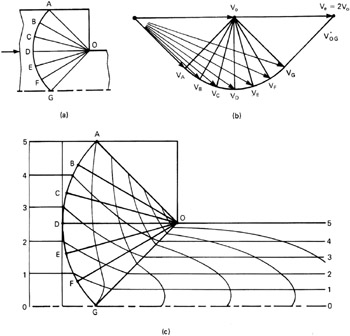
The distortion of the metal in a steady-state process can be determined from a slip-line field and its hodograph. As an example, consider the 2:1 extrusion through a 90 die illustrated in Figure 9.14(a).


Figure 9.14: (a) Slip-line field for a 2:1 extrusion through a 90 die, (b) the hodograph for the field, and (c) the predicted distortion of the metal.

Figure 9.14(b) is the hodograph. The triangle to the right of AO is a dead metal zone. A metal entering the field at A suffers a velocity discontinuity parallel to the arc at A. A metal entering the field at C suffers a velocity discontinuity parallel to the arc at C. All of the velocity discontinuities along the arc have the same magnitude and are parallel to the arc. There is also a velocity discontinuity parallel to GO and of magnitude such that V e is horizontal.

Stream lines can be drawn for particles (Figure 9.14(c)). Consider a particle on line 3, entering the field between C and D. As it enters the field it acquires an absolute velocity midway between V C and V D. Its direction gradually changes as it moves through the field. Its velocity equals V D as it crosses OD, equals V E as it crosses OE, and equals V F as it crosses OF. When it crosses OG its velocity must become horizontal. If this construction is made correctly, it emerges...

UNLIMITED FREE
ACCESS
TO THE WORLD'S BEST IDEAS

SUBMIT
Already a GlobalSpec user? Log in.

This is embarrasing...

An error occurred while processing the form. Please try again in a few minutes.

Customize Your GlobalSpec Experience

Category: Extrusion Machines
Finish!
Privacy Policy

This is embarrasing...

An error occurred while processing the form. Please try again in a few minutes.