Metal Forming: Mechanics and Metallurgy, Third Edition
Chapter 9: Slip-Line Field Analysis

9.1 INTRODUCTION

Slip-line field theory is based on analysis of a deformation field that is both geometrically self-consistent and statically admissible. Slip lines [*] are planes of maximum shear stress and are therefore oriented at 45 to the axes of principal stress. It is assumed that

  1. the material is isotropic and homogeneous,

  2. the material is rigid ideally plastic (i.e., no strain hardening),

  3. effects of temperature and strain rate are ignored,

  4. plane-strain deformation prevails, and

  5. the shear stresses at interfaces are constant: usually frictionless or sticking friction.

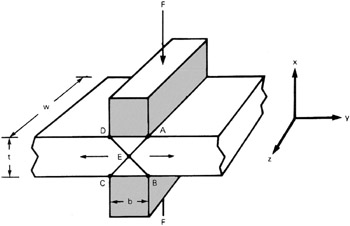
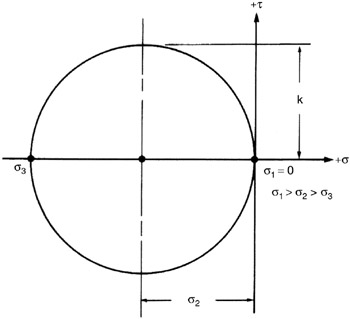
Figure 9.1 shows the very simple slip line for indentation where the thickness, t, equals the width of the indenter, b. The maximum shear stress occurs on line DEB and CEA. The material in triangles DAE and CEB is rigid. As the indenters move closer together the field must change. However, for now, we are concerned with calculating the force when the geometry is as shown. The stress ? y must be zero because there is no restraint to lateral movement. The stress ? z must be intermediate between ? x and ? y. Figure 9.2 shows the Mohr s circle for this condition. The compressive stress necessary for this indentation is ? x= ?2 k. Few slip-line fields are composed of only straight lines. More complicated fields will be considered.


Figure 9.1: A slip-line field for frictionless plane-strain indentation.

Figure 9.2: Mohr s stress circle for frictionless plane-strain indentation in Figure...

UNLIMITED FREE
ACCESS
TO THE WORLD'S BEST IDEAS

SUBMIT
Already a GlobalSpec user? Log in.

This is embarrasing...

An error occurred while processing the form. Please try again in a few minutes.

Customize Your GlobalSpec Experience

Category: Deflectometers and Extensometers
Finish!
Privacy Policy

This is embarrasing...

An error occurred while processing the form. Please try again in a few minutes.