The effects of strain hardening on flow stress were treated in Chapter 3. However, flow stress also depends on strain rate and temperature, usually increasing with strain rate and decreasing with temperature. The effect of strain rate at constant temperature will be considered first.
5.1 STRAIN RATE
Flow stress usually increases with strain rate. The strain-rate effect at constant strain can be approximated by
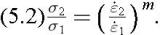
where C is a strength constant that depends upon strain, temperature, and material, and m is the strain-rate sensitivity of the flow stress. For most metals at room temperature, the magnitude of m is quite low (between 0 and 0.03). The ratio of flow stresses, ? 2 and ? 1, at two strain rates,  and
and  , is
, is
Taking logarithms of both sides, ln ( ? 2 / ? 1 )= m ln  . If, as is likely at low temperatures, ? 2 is not much greater than ? 1 , equation 5.2 can be simplified to
For example, if m=0.01, increasing the strain rate by a factor of 10 would raise the flow stress by only  , which explains why rate effects are often ignored.
However, rate effects can be important in some cases. For example, if one wishes to predict forming loads in wire drawing or sheet rolling (where the strain rates may be as high as 10 4/sec) from data obtained in a laboratory tension test, in which the...

 TABLE OF CONTENTS