Metal Forming: Mechanics and Metallurgy, Third Edition

Chapter 17: Other Sheet-Forming Operations

17.1 ROLL FORMING

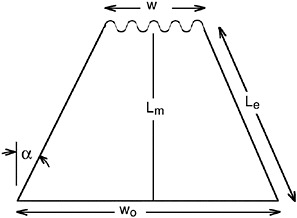
Roll forming transforms a flat sheet into another shape. As the new shape is formed over some distance, its width generally decreases as illustrated in Figure 17.1. During this transformation, the length of the edge must increase. The length must be sufficiently long so that the stretching is elastic. Otherwise, the edge will be longer than the centerline after the forming is complete and caused the formed sheet to warp. [*] The strain along the edge is


but


where


Figure 17.1: Stretching of the edge as a sheet is roll formed into a corrugated sheet.

EXAMPLE 17.1: How long must L m be if a sheet 6 feet wide contracts to 4 feet wide? Assume that yielding will occur when the strain reaches 0.002.

SOLUTION: L e /L m=exp(0.002)=1.002.


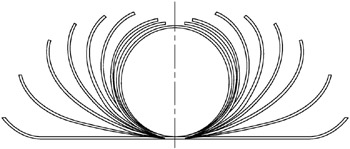
Roll forming is used to make welded tubes. Figure 17.2 shows the progressive change of shape.


Figure 17.2: Progressive shapes in roll forming of a tube from a flat sheet. From H.Singh, Fundamentals of Hydroforming (SME, 2003).

[*] The author is indebted to J.L.Duncan for this concept.

17.2 SPINNING

Spinning is a sheet-forming process that is suitable for axially symmetric parts. A tool forces the sheet metal disc to conform to a mandrel as shown in Figure 17.3. The tool usually consists of a small wheel. The process should be controlled so that all of the deformation is pure shear under the tool. If the tool causes more thinning than would...

UNLIMITED FREE
ACCESS
TO THE WORLD'S BEST IDEAS

SUBMIT
Already a GlobalSpec user? Log in.

This is embarrasing...

An error occurred while processing the form. Please try again in a few minutes.

Customize Your GlobalSpec Experience

Category: Plate Forming Services
Finish!
Privacy Policy

This is embarrasing...

An error occurred while processing the form. Please try again in a few minutes.