10.1 THE ? PARAMETER
The shape of the deformation zone has a strong influence on the redundant work, the frictional work, and the forming forces. It also influences the properties of the product material. The homogeneity, the tendency to crack, the pattern of residual stresses, and the porosity are all affected by the deformation-zone geometry. The parameter ?, defined as the ratio of the thickness or diameter, H, to the contact length between work piece and die, L, has a large effect on these properties:
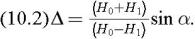
For plane-strain extrusion and drawing, the contact length L= (H 0 ?H 1 )/(2 sin ?) and the mean thickness H= (H 0+ H 1 )/2, so
Substituting the reduction r=(H 0 ?H 1 )/H 0 ,
Equation 10.2 holds for axisymmetric extrusion and drawing, where H is the diameter, so  , so
, so
Note that for the same ? and r, equation 10.3 gives a ? value for axisymmetric deformation about twice that for plane strain (equation 10.2).
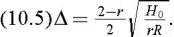
For flat rolling, ? is simply the mean height (H 0+ H 1 )/2= H 0(2 ? r)/2 divided by the contact length  (equation 7.34), or
Slightly different definitions of ? are used elsewhere. [*] In all of the equations, ? increases with die angle and decreases with reduction.

 TABLE OF CONTENTS