Metal Forming: Mechanics and Metallurgy, Third Edition
Chapter 18: Formability Tests

There are many tests of formability for sheet materials. A given test may correlate well with behavior in one type of forming process and poorly with behavior in another. This is because the relative amounts of drawing and stretching vary from test to test and process to process.

18.1 CUPPING TESTS

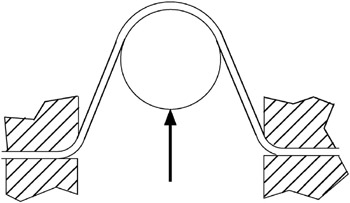
The Swift cup test is the determination of the limiting drawing ratio for flat-bottom cups. In the Erichsen and Olsen tests, cups are formed by stretching over a hemispherical tool. The flanges are very large so little drawing occurs. The results depend on stretchability rather than drawability. The Olsen test is used in America and the Erichsen in Europe. Figure 18.1 shows the setup.


Figure 18.1: Olsen and Erichsen tests.

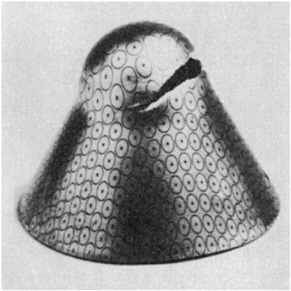
The Fukui conical cup test involves both stretching and drawing over a ball. The opening is much larger than the ball so a conical cup is developed. The flanges are allowed to draw in. Figure 18.2 shows the setup. A failed Fukui cup is shown in Figure 18.3.


Figure 18.2: Fukui test.

Figure 18.3: Failed Fukui cup. Courtesy of Institut de Recherches de la Sid rurgie Fran aise.

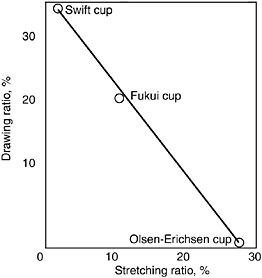
Figure 18.4 shows comparison of the relative amounts of stretch and draw in these tests.


Figure 18.4: Relative amounts of stretching and drawing in these cupping tests.

18.2 LDH TEST

The cupping tests discussed above are losing favor because of irreproducibility. Hecker [*] attributed this to insufficient size of the penetrator, inability to prevent inadvertent drawing in of the flange, and inconsistent...

UNLIMITED FREE
ACCESS
TO THE WORLD'S BEST IDEAS

SUBMIT
Already a GlobalSpec user? Log in.

This is embarrasing...

An error occurred while processing the form. Please try again in a few minutes.

Customize Your GlobalSpec Experience

Category: Weather Instruments
Finish!
Privacy Policy

This is embarrasing...

An error occurred while processing the form. Please try again in a few minutes.