Ship Design and Construction, Volume II

Dedicated to the design of individual ship types, this volume provides historical development and and general arrangement plans of tankers, bulk carriers, fishing vessels, dredgers, and more.
 TABLE OF CONTENTS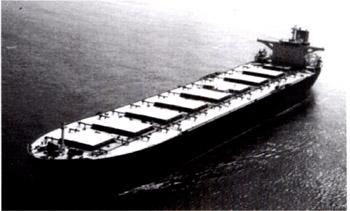
According to the SOLAS (Safety Of Life At Sea) Chapter XI-Reg.1, a bulk carrier is defined as a ship which is constructed generally with single deck, topside tanks and hopper-side tanks in cargo spaces. A bulk carrier is intended primarily to carry dry cargoes in bulk, and includes such types as ore carriers and combinations carriers (1). Modern conventional bulk carriers have been built based on the SOLAS definition.
Terminology used by the major classification societies is that a bulk carrier is a vessel designed for the carriage of bulk cargoes, or a seagoing vessel having single deck with machinery aft for carrying bulk dry cargoes. The SOLAS definition is relatively limited, and thus general cargo vessels, containerships carrying bulk cargoes, and double-skinned bulk carriers are not included in the definition. In general, a bulk carrier means a ship carrying dry bulk cargoes such as ore, coal, grain, and having topside and hopper-side tanks with corrugated transverse bulkheads.
The origin of modern bulk carriers is not known explicitly. It is known that the first modern-type bulk carrier had topside and hopper tanks similar to modern dry bulk carriers (2). Before the introduction of the modern concept, double bottom structure was adopted for single deck ships in 1890. Triangular-shaped topside tank structure was introduced for a cantilever-framed ship in 1905.
Types of bulk carriers by size in deadweight...