Ship Design and Construction, Volume II
Dedicated to the design of individual ship types, this volume provides historical development and and general arrangement plans of tankers, bulk carriers, fishing vessels, dredgers, and more.
 TABLE OF CONTENTS
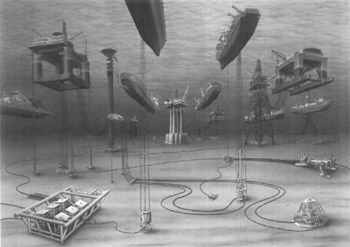
 Offshore Drilling and production vessels are industrial vessels primarily utilized in the petroleum industry for exploration and exploitation of subsea resources. Today the variety of platforms involved in the offshore world is great as can be seen from Figure 43.1.
In order to accomplish the ultimate mission of recovering hydrocarbons from below the seabed, the following major activities involving offshore vessels must take place, some of which may overlap:
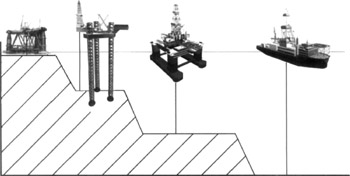
Exploration drilling: The search for hydrocarbons by drilling a hole (well) into the seabed to determine reservoir location and estimate size. The fleet of offshore drilling vessels, or MODUs (Mobile Offshore Drilling Units) is primarily comprised of the following basic types (Figure 43.2):
Jack-up unit,
Semi-submersible and fixed height submersible units, and
surface units, such as ships and barges
Production well testing: To measure production rates of flow from an exploratory well and estimate field life. The produced fluids are normally disposed of by burning if accomplished on the drilling vessel due to a lack of on-board storage capability. If extended well testing is undertaken it is carried out using a production tanker that can facilitate the conservation of produced hydrocarbons.
Development drilling: the drilling of a large number of wells through which hydrocarbons flow to a production facility for processing, transportation and sale. This activity can be carried...