Ship Design and Construction, Volume II
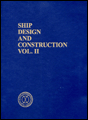
Dedicated to the design of individual ship types, this volume provides historical development and and general arrangement plans of tankers, bulk carriers, fishing vessels, dredgers, and more.
 TABLE OF CONTENTS
 The mission of aircraft carriers is to provide sea-based tactical aviation. Simply put, the goal is to gain air superiority in the vicinity of the aircraft carrier battle group and to exploit it to accomplish naval warfare tasks.
A major task is power projection, that is, land attack by manned bombers. While historians of WWII devote considerable attention to the major carrier-vs-carrier set-piece battles (Coral Sea, Midway, Marianas, and Leyte Gulf), during the war as a whole, 75% of carrier strikes were against land targets after establishing local air superiority. Of course, then as now, power projection also means attacking enemy shipping.
A second task is battle space dominance. A modern aircraft carrier battle group (aircraft carrier plus surface escorts and direct support submarines) can control over a million square miles of the ocean surface. The center of this area can translate over 500 miles/day, in any direction.
Aircraft carriers, in conjunction with other ships, also control the sea lines of communications. During the Gulf Wars the majority of allied ground forces arrived by air, but 95% of the material that they needed on a continuous basis came by sea. This same material percentage was true of the Vietnam War. Access to and unrestricted use of the sea-lanes is essential. A submarine may be able to deny use of the sea-lanes to an adversary, as German U-boats attempted to do in both World Wars, but control of the sea-lanes...