Ship Design and Construction, Volume II
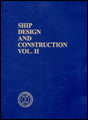
Dedicated to the design of individual ship types, this volume provides historical development and and general arrangement plans of tankers, bulk carriers, fishing vessels, dredgers, and more.
 TABLE OF CONTENTS
 Rather than being a specific ship type configured to undertake a transportation or operational mission, multi-hulled configurations are options to be explored by the ship designer in the early exploratory phases of the ship design process for many operational scenarios. Furthermore, certain multi-hulls have particular capabilities that make them attractive options to be considered in comparison with the ubiquitous monohull. Thus, for example if a design has to meet a requirement for a fast short ferry route the designer may well choose a catamaran, possibly with a wave piercing configuration. This form, which was first introduced on an economic basis in Australia, has become a successful ship type providing an increasingly large proportion of the fast ferry market around the world and with an ever-increasing size range. It is for this reason that a separate chapter (Chapter 45) is devoted to the high-speed catamaran ferry type. The present chapter consequently focuses on the wider range of multi-hulls, and in particular the Small Waterplane Twin Hull (SWATH) vessel and the Trimaran ship type, namely, a slender monohull with small-displacement outriggers.
There are in addition variants of these two basic configurations, such as the SLICE and the Pentamaran, which will also be considered as sub-variants of the two main configurational types. Beyond them are certain of the hybrid advanced hull forms, such as the Surface Effects Ship (SES), a variant of the high speed Air Cushion Vehicle (ACV) with some buoyancy based lift from the two...