Ship Design and Construction, Volume II
Dedicated to the design of individual ship types, this volume provides historical development and and general arrangement plans of tankers, bulk carriers, fishing vessels, dredgers, and more.
 TABLE OF CONTENTS
 The role of a ferry is the routine and continuous transport of people, their associated baggage, vehicles and trains. This is a transport role though entertainment and shopping opportunities may be part of the marketing tools. Ferry payloads range from passengers only to vessels carrying passengers plus their accompanying cars, trucks, trailers, and trains. Figure 38.1 shows a conventional multi-purpose (passenger, vehicle and train) ferry as is typical in the Baltic Sea. Some ferries operate only nighttime services with full passenger/crew sleeping accommodation; others operate a continuous 24-hour service with limited sleeping facilities. The majority of ferries, however, operate as day ferries with no sleeping accommodation for passengers. Ferries travel in sheltered waters, on the open ocean and in ice conditions. Their safety conditions are subject to IMO Safety of Life at Sea (SOLAS) or the newer IMO High Speed Craft (HSC) Code and in Northern Europe to the Stockholm Agreement for water on the vehicle deck.
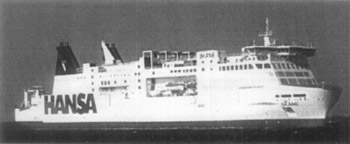
In Europe alone, more than 100 million people travel every year on car ferries. There are millions more travelling as commuters on passenger only ferries. This chapter will provide some material on low-wash passenger ferries for inland waterways. However the main focus is on the design and construction of vehicle ferries. This type of ferry is characterized by having one or more unobstructed decks for Ro-Ro cargo in almost the full length of the vessel. On a...