Ship Design and Construction, Volume II
Dedicated to the design of individual ship types, this volume provides historical development and and general arrangement plans of tankers, bulk carriers, fishing vessels, dredgers, and more.
 TABLE OF CONTENTS
 Offshore oil and gas exploration and production became one of the world's leading economic activities in the late 20th century. As reserves under dry land became more closely defined, the focus moved to examine the extent to which oil and gas might be recoverable from the sea bed. By trial well drilling, and increasingly by seismic surveying, the location of reserves under the continental shelves is being mapped and the trend has been to move into ever deeper and more hostile waters.
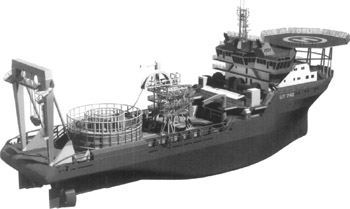
To exploit these resources a large industry has grown up employing floating drilling rigs, ships and moored or fixed production platforms. These various units require different types of support operation and to supply this support a range of vessel types has been developed over the years. Figure 42.1 is a perspective view of a large multifunctional anchor handling tug/supply and subsea service vessel, the 95 m long design UT742 from Rolls-Royce. Sub sea trenching can be undertaken using the A-frame and the vessel is shown with equipment for laying flexible pipe through one of the two moonpools.
Offshore support vessels are typically operated by shipowners: either companies set up specifically to own and operate such vessels or companies which combine offshore support vessel operation with other activities such as towage and salvage, conventional ship owning, or other industrial and business activities. Offshore oil and gas exploration and production is in the hands of numerous organizations. These range from...