Ship Design and Construction, Volume II
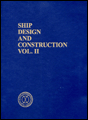
Dedicated to the design of individual ship types, this volume provides historical development and and general arrangement plans of tankers, bulk carriers, fishing vessels, dredgers, and more.
 TABLE OF CONTENTS
 The mission of combat logistic force (CLF) ships is to resupply naval ships at sea. In peacetime this includes food, fuel, repair parts, and other consumables. In wartime, ammunition (and increased quantities of aviation fuel) must also be provided. This enables modern naval forces to stay at sea for extended periods of time, providing sustainability, which is an important military capability.
The shift from sail power to steam power produced enormous advantages by making ships essentially independent of wind and current. On the other hand, ships were now dependent on an outside source of fuel, first wood, then coal, and now fuel oil. Refueling was accomplished in port or in a protected anchorage. Navies with overseas interests established coaling stations throughout their areas of interest.
During wartime, however, friendly ports might not be available, or at least not close-by. Experiments with refueling from coal carriers (colliers) in protected anchorages started during the Spanish-American War. During WWI underway refueling of destroyers had some success, although operations were limited to daytime and fair weather. The shift from coal to fuel oil enormously eased the refueling problem.
Throughout the first half of WWII, naval ships were resupplied at forward bases. Single product (commercial) ships delivered a steady stream of fuel, ammunition and stores to these bases. Underway replenishment had been experimented with during the 1920s and 1930s, but the technology was little advanced since WWI.
During the last 2...