
Condensers Information

Condensers are devices which accept a vapor stream and convert it to a liquid using heat transfer and/or compression. A condenser may refer to a heat exchanger used specifically for cooling gases and process fluids below their boiling points. However, condensing units (such as those in air conditioners) are used in systems which cool the outside environment. These systems may include a compressor, an evaporator, fans, and other components in addition to a heat exchanger (condenser) section.
Types of Condensers
Condensers can be designed and sold as merely heat exchangers for condensing applications or as condensing units for HVAC systems.
Heat Exchangers
Heat exchanger condensers are used for the purpose of converting a gas to a liquid through heat transfer. Condensers can be built as either direct contact condensers or surface condensers depending on the method of heat transfer.
Direct contact condensers transfer heat through direct contact between the gas and the liquid. Since there is no boundary for separation, both the liquid and the gas must be of the same material (e.g. water and steam).
Indirect contact condensers transfer heat through a thermally conductive boundary layer, typically a plate, shell, or tube. The boundary layer permits heat transfer but prevents mixing or contamination of the fluid streams.
 Surface condensers are heat exchanger condensers most commonly designed for steam turbines in thermal power plants. Typically, these devices have a large well to collect the condensed steam. Surface condensers also have connections for air ejectors or other vacuum equipment to remove air and other substances that will not condense.
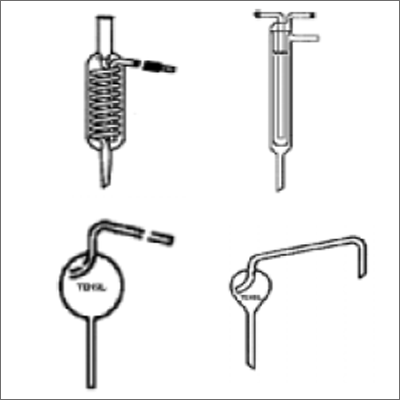
Laboratory condensers include a range of laboratory glassware parts used to remove heat from fluids. They are an essential component in distillation setups.
Shell and tube is the primary design for condenser heat exchangers, but other types such as plated and air-cooled are also used, depending on the application. For more insight into the different types of heat exchangers and their specifications and applications, visit the Heat Exchangers Selection Guide on Engineering 360.
Condenser Units
 Condenser units are typically components of larger systems used to cool an environment through the evaporation and condensation of a fluid. In these systems, a cool fluid (typically a refrigerant) enters into a compressor which raises its temperature through compression. It then enters the condenser section which removes heat to the outside environment, converting it to a liquid. After uncondensed particles are removed in a drier or collector, the fluid enters an expansion joint which relieves pressure and cools it down. Finally, the fluid enters an evaporator which collects heat from the target environment (area being cooled) to evaporate the fluid and send it back to the compressor as a gas.
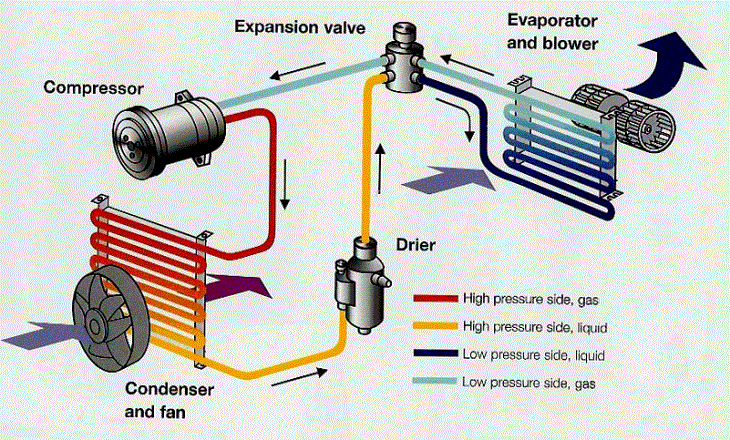
Image credit: PC Magnum
Condensing units are used in heating, ventilation, and air conditioning (HVAC) systems of all types. They may be purchased as standalone cooling units or merely components to larger HVAC systems. Depending on the application, they may incorporate some or all of these different parts (described above):
- Heat exchange condenser
- Heat exchange evaporator
- Compressor
- Drier
- Expansion valve(s)
- Fans and blowers
- Vacuum or refrigerant pump(s)
- Condensate collector/basin
- Motor
- Pump
Coolants and Refrigerants
When sourcing a condenser for an HVAC application, users may need to select a coolant to be used. There are a large number of refrigerants available; most are designated with number names based on ASHRAE refrigerant designations. Refrigerant performance depends primarily on its coefficient of performance (COP) which denotes its heat transfer efficiency, and its boiling point, which must be appropriate for the design temperatures of the system. Other factors such as material compatibility and viscosity need to be considered as well. Refrigerants are also selected and regulated based on safety properties such as flammability and toxicity, and environmental properties such as global warming potential (GWP) and ozone depletion potential (ODP).
Materials of Construction
Condenser materials (particularly those for the sections in contact with the fluid streams) are important to the design and selection process. Coolant selection in refrigeration applications often coincides with material selection. Common materials include copper, brass, aluminum, and stainless steel.
Copper has the best heat transfer performance of all metals commonly used in condeners due to its high thermal conductivity. However, by itself copper has relatively poor corrosion resistance to more aggressive fluids. It is commonly used with water and many standard coolants.
Brass, an alloy of copper and zinc, is stronger than copper while still retaining high thermal conductivity for efficient heat transfer. Brass still suffers from corrosion resistance, but can be alloyed with zinc for more resilience at the cost of heat transfer performance.
Aluminum is a lightweight metal with high heat transfer efficiency at a comparatively low cost. Aluminum used in condensers is commonly alloyed with bronze and nickel to increase its corrosion resistance.
Stainless steel is an alloy of steel with excellent corrosion resistance. Stainless steel has a comparatively lower heat transfer efficiency and higher cost than metals. It is best suited for working with corrosive refrigerants and fluids.
Specifications
Condensers are typically constructed according to certain specifications set by the client. These specifications are typically included on a manufacturer's sheet for condenser design and selection.
Flow rate defines the rate at which the fluid (streams) in the condenser move through the system, measured in gallons per minute (gpm) for liquids and cubic feet per minute (cfm) for gases.
Design pressure or operating pressure defines the highest fluid pressures the system is designed to handle during normal operation, typically given in pounds per square inch (psi). Pressures are indicated for both sides of the condenser as applicable to the design.
Design temperature or operating temperature defines the highest and lowest fluid temperatures the system is designed to handle during normal operation. Temperatures are indicated for both sides of the condenser as applicable to the design.
Allowable pressure drop defines the highest pressure drop acceptable in the system. Systems which allow for higher pressure drops require more pumping power, but can handle higher flow rates and longer tube lengths which can result in more efficient heat exchange.
Condensing capacity defines the amount of fluid that the condenser is designed to condense, measured in pounds per hour (lb/hr).
Coolant capacity or refrigerant capacity defines the amount of refrigerant that the condensing unit holds. This capacity rating is associated with condenser size and the length of the tubing within the unit.
Applications
Condensers vary significantly based on the application they are built for. The Engineering360 SpecSearch Database includes the most common condenser applications.
- Automotive - condensers designed for use in automotive or vehicular air conditioning systems (e.g. cars, planes, trains).
- Building - condensers used to provide central air conditioning for buildings. They can be mounted outdoors, either on the ground or rooftop.
- Process - condensers used in cooling units for in-process fluids.
- Refrigeration - condensers used in refrigeration systems.
- Steam power turbine - Surface condensers used in power generation facilities such as nuclear power plants to condense turbine exhaust steam into water.
Standards
A number of standards are associated with condensers which certify performance, environmental compliance, and safety. Organizations which provide standards and certifications include AHRI, ASHRAE, ASME, ASTM, and HEI.
The Air-Conditioning, Heating, and Refrigeration Institute (AHRI) are the heating and cooling industry authority on product and performance ratings. They administer performance tests for cooling and commercial refrigeration equipment and components. Condensers which meet their standards are considered ARI Performance Certified®.
The American Society of Heating, Refrigerating, and Air-Conditioning Engineers (ASHRAE) is an organization revolving around engineers in the HVAC industry. They develop standards for refrigeration processes and the design and maintenance of indoor environments. Most notable are their standards on refrigerant usage in cooling units.
The American Society of Mechanical Engineers (ASME) is an organization dedicated to providing standards and resources for engineers. They provide leading design standards for many different types of technology and equipment, including condensers.
The American Society for Testing and Materials (ASTM) is a recognized leader in developing international voluntary consensus standards. They provide testing and performance standards for materials used to construct condenser tubes and other components.
The Heat Exchange Institute (HEI) is a leading standards development organization for heat exchange and vacuum apparatus. They issue performance and design standards for different types of condensers.
Image credits:
Heat Controller, Inc. | Carrier Commercial Products | Tensil Glass Works
- barometric condenser
- shell and tube condenser
- vacuum condenser
- Electret condenser
- steam surface condenser
- low temperature condensing unit
- steam condenser
- custom automotive AC condensers
- deaerator vent condenser
- direct contact condensers
- electric motor condensers
- evaporative cooled condensers
- frigid coil condensers
- fuel cell condensers
- gas liquid condensers
- gland steam condensers
- graham steam surface condensers
- liquid nitrogen condensers
- natural gas condensers
- power plant condensers
- refrigerated vent condensers
- refrigeration water cooled condensers
- spiral heat exchanger condensers
- steam turbine air cooled condensers
- steam turbine surface condensers
- steam turbine vacuum condensers
- storage tank vent condensers
- tank vent condensers
- VOC Vent Condenser
- water cooled steam condensers