
Passive Components Automated Test Equipment
Description
Passive Components Automated Test Equipment (ATE) is designed to test passive components such as capacitors, resistors, and inductors. The equipment applies a test current to these components to evaluate their performance and ensure they meet specified standards.
Working Principle
The working principle of Passive Components ATE involves applying a test current to the passive components and measuring their response. This process helps in determining the electrical characteristics of the components, such as resistance, capacitance, and inductance. The equipment is useful because it allows for quick and accurate testing of components, ensuring they function correctly within electronic systems. Automated testing minimizes human error and increases efficiency by providing repeatable and consistent results.
Applications
Passive Components ATE is used in various applications, including the testing of printed circuit boards (PCBs) and integrated circuits (ICs). It is particularly useful in high-volume manufacturing environments where quick confirmation of component functionality is essential. For example, it can be used to test the capacitors and resistors on a PCB to ensure they meet design specifications before the board is assembled into a larger electronic device.
Advantages over other Automated Test Equipment
One of the main advantages of Passive Components ATE over other types of automated test equipment is its ability to efficiently test a wide range of passive components with minimal human interaction. This reduces testing time and increases cost efficiency, especially in high-volume production settings. Additionally, the equipment's ability to pinpoint defects quickly helps in maintaining high-quality standards in manufacturing processes.
Limitations
A limitation of Passive Components ATE is the upfront cost associated with programming and setup. This can be a significant investment for companies, especially those with limited budgets. Additionally, the equipment may have limitations in testing components with very high density or complex configurations, where precise contact placement is required.
Considerations
When considering Passive Components ATE, it is important to evaluate the initial costs, which include the purchase price and setup expenses. Operating expenses should also be considered, as they can impact the overall cost-effectiveness of the equipment. Durability and accuracy are crucial factors, as they determine the long-term reliability and performance of the testing process. Replacement and maintenance costs should be factored into the decision-making process to ensure the equipment remains functional and efficient over time.
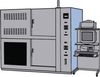
from CHINO Works America Inc.
The equipment is semiconductor aging testing equipment to full-automatically execute burn-in processing and data measurement/judgment/analytical processing and also has tester function as well as temperature accelerating testing. [See More]
- Component / Product Tested: MEMS or Electromechanical Devices; Passive Components; Loaded PCBs; Power Supplies or Transformers; Optoelectronics; Semiconductors or Active Components
- Tester / Test Capability: Life or Endurance Test; Functional
- Type / Form: Platform or Turnkey System; Output Measurement or Monitoring Unit; Input Stimulus or Signal Source Unit; Fixture / Interface
- Interface: Floating Probe